Bronze Cory Care Guide
Corydoras aeneus · Easy care · 20 gallon minimum
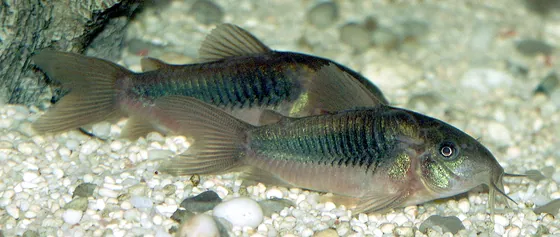
The hardiest, most beginner-friendly corydoras; a tireless, peaceful sand-sifter best kept in groups.
Check your stocking with the stocking calculator →
How big does a bronze cory get?
A bronze cory (Corydoras aeneus) reaches about 2.8 inches as an adult. Plan tank size and tank mates around the adult size, not the small fish you buy at the store.
Tank size & setup
Give a bronze cory a minimum of 20 gallons, with water at 72–79°F and a pH of 6–8. Keep them in groups of at least 6 — they are shoaling fish and become stressed and washed-out alone. As a easy-care, omnivore species, a stable, cycled tank with the right diet keeps them healthiest.
Good tank mates
Pair a bronze cory with peaceful species that share its temperature and pH range. Compatible options include:
- Neon Tetra — 1.5", 10g min
- Guppy — 2.0", 10g min
- Molly — 4.0", 20g min
- Platy — 2.5", 10g min
- Zebra Danio — 2.0", 10g min
About the bronze cory
The bronze corydoras, also known as the green corydoras, bronze catfish, lightspot corydoras or wavy catfish, is a species of freshwater fish in the armored catfish family, Callichthyidae, often kept as an aquarium fish. It is widely distributed in South America on the eastern side of the Andes, from Colombia and Trinidad to the Río de la Plata basin; however, as presently defined it is a species complex and a taxonomic review is necessary. It was originally described as Hoplosoma aeneum by Theodore Gill in 1858 and has historically also been referred to as Corydoras aeneus.
Recommended gear for bronze corys
As an Amazon Associate we earn from qualifying purchases.